
Abstract. Numerology attributes mystical significance to certain numbers based on apparently deep patterns. Rather than refuting such claims case by case, this work adopts the reverse strategy: openly constructing a rigorous mathematical system in which every natural number converges to 7 by design, and developing its complete theory. We define the piecewise function F₇: ℕ → ℕ (fixed point at 7, integer division above 7, and unit increment below) and prove: (i) the universal convergence of every orbit to the fixed point 7; (ii) an exact closed form for the convergence time, T(n) = ⌊log₂ n⌋ + 5 − ⌊n / 2^(⌊log₂ n⌋−2)⌋ for n > 7, from which the optimal band ⌊log₂ n⌋ − 2 ≤ T(n) ≤ ⌊log₂ n⌋ + 1 follows; (iii) the complete characterization of the extremal values, including the identities T(2^k) = k+1 and T(2^j − 1) = j−3; and (iv) the exact uniform distribution of T in each dyadic octave, with mean ⌊log₂ n⌋ − 1/2. Exhaustive computational verification for 1 ≤ n ≤ 10⁷ confirms all the results. The same construction works for any target k (the F_k family), which shows that the «specialness» of 7 is manufacturable: formal correctness, abundant computational evidence, and the appearance of depth can be produced at will without epistemic content. We discuss the implications for the demarcation between mathematics and pseudoscience and for mathematics education.
Keywords: discrete dynamical systems; convergence; fixed point; philosophy of mathematics; demarcation; pseudoscience; numerology; mathematics education. MSC 2020: 00A30, 37E99, 11A99, 97A80.
Downloads and code: Manuscript in PDF · LaTeX source · Repository with code and data
1. Introduction
1.1 Motivation
Numerology, the attribution of mystical, predictive, or causal properties to numbers, is one of the most persistent pseudosciences. The number 7 holds a prominent place in that tradition: it is declared «perfect», «sacred», or «cosmic» in multiple cultures, and its alleged singularity rests on selective counts (seven days of the week, seven musical notes, seven colors of the rainbow) that confuse cultural conventions with intrinsic mathematical properties (Gardner, 1957, 1985).
The epistemological trait that makes numerology hard to dislodge is that it knows how to dress as mathematics: its promoters display correct calculations, abundant tables, and impeccable formal syntax. Case-by-case refutation is then insufficient, because each refuted instance can be replaced by another built with the same technique. What is needed is to expose the technique itself.
1.2 Strategy: refutation by construction
This work adopts the reverse of the usual strategy. Instead of discussing numerological claims one by one, we openly construct a complete, rigorous, and verifiable mathematical system in which every natural number converges inevitably to 7, and we confess from the outset that the result is built into the design. We then develop the theory of the system with the same apparatus a «genuine» mathematics paper would display: formal definitions, lemmas, theorems with proofs, optimal bounds, time distribution, and exhaustive computational verification.
The anti-numerological argument is then direct: if we can manufacture in a few pages a formally impeccable system whose central theorem is «everything converges to 7», and if the same manufacture works for any other target k with the same effort, then mathematical convergence toward a number carries, by itself, no mystical significance. The construction acts as an intellectual vaccine: a controlled, transparent dose of the same procedure that pseudoscience employs opaquely.
The idea has a philosophical pedigree. That mathematical objects are human constructions and not revealed entities is the thesis of the constructivism of Brouwer (1907) and Bishop (1967); that mathematical knowledge develops through conjectures, proofs, and refutations within a community is the lesson of Lakatos (1976); and that mathematical necessity is often convention in disguise is the observation of Wittgenstein (1956). Our system takes those theses to a deliberate limiting case: a formally blameless and epistemologically empty object, built to be so.
1.3 Contributions and organization
The contributions are of three kinds. Mathematical: a complete quantitative theory of the system, including universal convergence (Theorem 3.1), an exact closed form for the convergence time (Theorem 3.4), finer than the logarithmic band usual in this kind of analysis, the characterization of the extremal values (Proposition 3.6), and the exact uniform distribution of the time in each dyadic octave (Theorem 3.8). Computational: exhaustive and independent verification of every statement for 1 ≤ n ≤ 10⁷, with public code and data. Philosophical: a controlled case study on the difference between formal correctness and mathematical meaning, with heuristic demarcation criteria and teaching applications.
Section 2 defines the system and establishes its elementary properties. Section 3 contains the main results. Section 4 describes the computational verification. Section 5 contrasts the system with the Collatz conjecture and the Kaprekar process. Section 6 presents the F_k family and two variants (random and real). Sections 7–9 discuss the philosophical implications, the limitations, and the conclusions.
1.4 Related work
The position of the present experiment in the literature is easily summarized: all of its ingredients are known, but we have not found the recipe. The central dynamical ingredient, the binary shift n ↦ ⌊n/2⌋, belongs to the algorithmic folklore of base-2 expansion, and the literature on variants of the 3x+1 problem studies the hard cases (q ≥ 3) while leaving precisely the trivially convergent case offstage (Crandall, 1978; Franco and Pomerance, 1995); the stochastic models with random multipliers (Lagarias and Weiss, 1992) and the continuous extensions (Chamberland, 1996) likewise do not contemplate the degenerate case analyzed here. The deliberate manufacture of «numerical magic» does have illustrious precedents, however: Conway’s FRACTRAN language, whose fourteen-fraction program generates the prime numbers as powers of 2 (Conway, 1987; Guy, 1983), and Tupper’s self-referential formula, whose graph contains itself (Tupper, 2001), are artifacts designed with the result built in, and in engineering, pole assignment designs the dynamics from the desired behavior (Wonham, 1967). There is even a satirical tradition of formal rigor in the service of parody, inaugurated by Pétard’s celebrated article on the mathematical theory of big game hunting (Pétard, 1938).
On the philosophical front, the criticism of numerology has the classics of Gardner (1957, 1985) and the systematic studies of Dudley (1992, 1997). The closest antecedent of «manufactured significance» is statistical: the equidistant letter sequences of the Bible, published with formal apparatus in a serious journal and refuted by exhibiting the design decisions that produced them (Witztum et al., 1994; McKay et al., 1999), the analytic flexibility that allows anything to be presented as significant (Simmons et al., 2011), and the general theory of coincidences (Diaconis and Mosteller, 1989). Deceptions of form without content, from the Sokal experiment (1996) to the literature on the demarcation problem (Pigliucci and Boudry, 2013) and the characteristic mimicry of pseudoscience (Blancke et al., 2017), share the aim but not the method of the present work: here the content is formally correct, and that total correctness is what makes the experiment a limiting case for demarcation criteria. The notion of mathematical coincidence without a unifying explanation (Lange, 2010) points to the same explanatory void as our criteria in Section 7.
2. Definition of the system and elementary properties
In what follows, ℕ = {1, 2, 3, …} and ⌊x⌋ denotes the floor function. For n > 0 we write L(n) ≔ ⌊log₂ n⌋.
Definition 2.1 (The function F₇). We define F₇: ℕ → ℕ by cases:
F₇(n) = n           if n = 7
        ⌊n/2⌋       if n > 7 and n is even
        ⌊(n−1)/2⌋   if n > 7 and n is odd
        n + 1       if n < 7
Remark 2.2 (Cosmetic complexity). The case distinction by parity is formally unnecessary: for odd n, ⌊(n−1)/2⌋ = (n−1)/2 = ⌊n/2⌋, so the two central branches coincide and F₇(n) = ⌊n/2⌋ for every n > 7. We keep the parity notation because it is part of the object of study: it reproduces the syntax of the Collatz function (Section 5) and exemplifies how a partition of the domain can add an appearance of sophistication without adding mathematical content. No result in this work depends on that distinction.
Definition 2.3 (Orbit and convergence time). For n₀ ∈ ℕ, the orbit of n₀ under F₇ is the sequence O(n₀) = {n_k} with n_{k+1} = F₇(n_k). The convergence time is
T(n₀) ≔ min { k ∈ ℕ ∪ {0} : F₇^k(n₀) = 7 }where F₇^k denotes the k-th iterate of F₇; T(n₀) is defined only if such a k exists (Theorem 3.1 guarantees that it always does).
Example 2.4. O(20) = {20, 10, 5, 6, 7, 7, …} and T(20) = 4; O(100) = {100, 50, 25, 12, 6, 7, …} and T(100) = 5; O(3) = {3, 4, 5, 6, 7, …} and T(3) = 4.
Proposition 2.5 (Elementary properties). The following hold:
- F₇ is well defined: for each n ∈ ℕ exactly one condition of the definition holds, and the image belongs to ℕ.
- If n > 7, then 4 ≤ F₇(n) < n: the dynamics decreases strictly above 7.
- If n < 7, then F₇^k(n) = n+k for 0 ≤ k ≤ 7−n; in particular, F₇^(7−n)(n) = 7 and T(n) = 7−n.
- The only periodic point of F₇ is the fixed point 7 in the standard sense of discrete dynamics (Devaney, 2003): there are no cycles of length greater than 1.
- F₇ preserves neither algebraic structure nor order: it is non-injective (F₇(14) = F₇(15) = 7), it is not a homomorphism (F₇(2·8) = 7 ≠ 2 = F₇(2)·F₇(8)), and it does not preserve order (6 < 8 but F₇(6) = 7 > 4 = F₇(8)).
Proof. (i) The cases n < 7, n = 7, and n > 7 partition ℕ; parity partitions the case n > 7. The operations involved are closed in ℕ.
(ii) For n > 7: if n is even, F₇(n) = n/2 < n and n/2 ≥ 8/2 = 4; if n is odd, F₇(n) = (n−1)/2 < n and (n−1)/2 ≥ (9−1)/2 = 4.
(iii) Immediate induction on k using F₇(n) = n+1 in the range n < 7; the chain reaches exactly the value 7 after 7−n increments.
(iv) Suppose there is a cycle {a₁, …, a_m} with m > 1. If some a_i > 7, then a_{i+1} = F₇(a_i) < a_i by (ii), and the orbit cannot return to a_i without violating strict decrease: contradiction. If all a_i < 7, the orbit is strictly increasing by (iii) and reaches 7, which is a fixed point: there is no cycle of length > 1 either.
(v) It suffices to exhibit the indicated counterexamples, all verifiable by direct evaluation of the definition. □
Remark 2.6. Item (v) is not a defect but the mechanism: the compression of information (F₇ collapses pairs of consecutive values onto the same image) is what forces universal convergence. The system was not designed to preserve structure, but to destroy it in a controlled way; this absence of algebraic properties is one of the signals of artificiality that Section 7 records as a demarcation criterion.
3. Universal convergence and quantitative characterization
3.1 Universal convergence
Theorem 3.1 (Universal convergence). For every n₀ ∈ ℕ there exists k ∈ ℕ ∪ {0} such that F₇^k(n₀) = 7. Equivalently, T(n₀) < ∞ for every n₀.
Proof. If n₀ = 7, k = 0 suffices. If n₀ < 7, Proposition 2.5(iii) gives k = 7−n₀. Let then n₀ > 7 and consider the orbit {s_i} with s₀ = n₀. While s_i > 7, Proposition 2.5(ii) guarantees s_{i+1} < s_i and s_{i+1} ≥ 4. Every strictly decreasing sequence of integers bounded below is finite: by the well-ordering principle, there is a first index j with s_j ≤ 7. If s_j = 7, k = j; if s_j < 7, the ascending phase adds 7−s_j iterations and k = j + (7−s_j). □
Remark 3.2. The proof is constructive: it provides an algorithm (iterate F₇) that computes T(n₀) in O(log n₀) iterations. Note also that the argument uses no property of the number 7 beyond the structure of the rules: it is the first sign that the result is portable to any target (Theorem 6.2). Figure 1 illustrates the biphasic structure of a typical orbit.
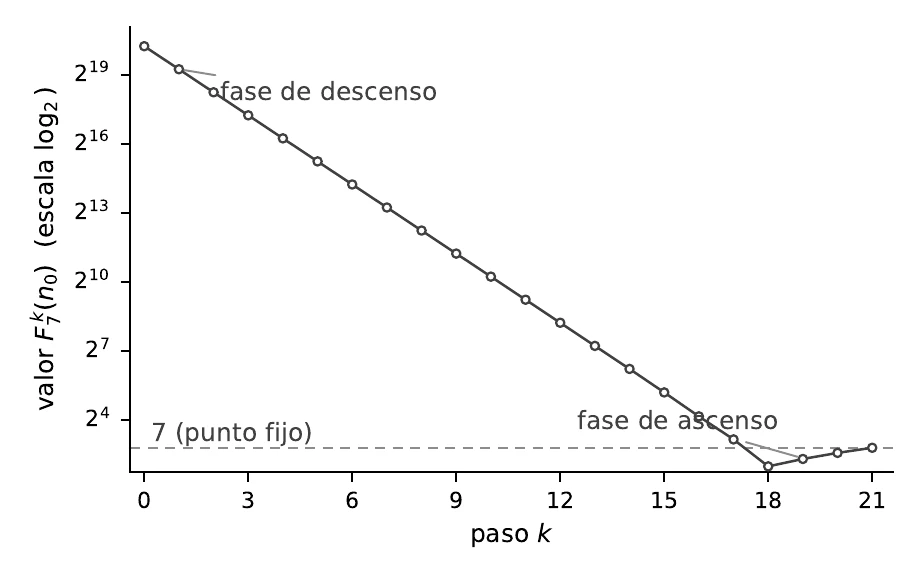 Figure 1. Biphasic dynamics of the orbit of n₀ = 1 234 567 (logarithmic scale on the vertical axis): geometric descent during L−2 = 18 steps down to m = ⌊n₀ / 2^(L−2)⌋ = 4 and linear ascent 4 → 5 → 6 → 7. The fixed point is reached in T(n₀) = 21 steps, the exact value given by formula (3.1).
3.2 Closed form for the convergence time
Lemma 3.3 (Iterates of the descent phase). Let n > 7 and L = L(n). For 0 ≤ j ≤ r ≔ L−2 we have
F₇^j(n) = ⌊n / 2^j⌋ ≥ 8 (j < r), m ≔ F₇^r(n) = ⌊n / 2^r⌋ ∈ {4, 5, 6, 7}.Proof. Since n > 7, we have L ≥ 3 and r ≥ 1. For j < r, ⌊n/2^j⌋ ≥ ⌊2^L / 2^j⌋ = 2^(L−j) ≥ 2^(L−r+1) = 8 > 7, so during the first r steps only the division branch acts. The identity ⌊⌊n/a⌋/b⌋ = ⌊n/(ab)⌋, valid for positive integers a, b, then gives F₇^j(n) = ⌊n/2^j⌋ by induction. At j = r: 4 = 2^(L−r) ≤ n/2^r < 2^(L+1−r) = 8, hence m = ⌊n/2^r⌋ ∈ {4, 5, 6, 7}. □
Theorem 3.4 (Closed form). For every n > 7, with L = ⌊log₂ n⌋:
T(n) = L + 5 − ⌊n / 2^(L−2)⌋ (3.1)Proof. By Lemma 3.3, after r = L−2 iterations the orbit reaches m = ⌊n / 2^(L−2)⌋ ∈ {4, 5, 6, 7} without having passed through 7 before (the previous values are ≥ 8). If m = 7, T(n) = r. If m ∈ {4, 5, 6}, Proposition 2.5(iii) adds exactly 7−m ascent steps. In both cases T(n) = r + (7−m) = (L−2) + 7 − ⌊n / 2^(L−2)⌋ = L + 5 − ⌊n / 2^(L−2)⌋. □
3.3 Optimal band and extremal values
Corollary 3.5 (Optimal band). For every n > 7:
⌊log₂ n⌋ − 2 ≤ T(n) ≤ ⌊log₂ n⌋ + 1. (3.2)Both bounds are attained with equality for infinitely many values of n. More precisely, with L = ⌊log₂ n⌋:
- T(n) = L−2 if and only if n ∈ [7·2^(L−2), 2^(L+1));
- T(n) = L+1 if and only if n ∈ [2^L, 5·2^(L−2)).
In particular, T(n) = Θ(log n).
Proof. Since m = ⌊n / 2^(L−2)⌋ ∈ {4, 5, 6, 7}, (3.1) gives T(n) = L+5−m ∈ {L−2, L−1, L, L+1}. The equality T(n) = L−2 is equivalent to m = 7, that is, 7·2^(L−2) ≤ n < 8·2^(L−2) = 2^(L+1). The equality T(n) = L+1 is equivalent to m = 4, that is, 4·2^(L−2) = 2^L ≤ n < 5·2^(L−2). Both intervals are non-empty for every L ≥ 3. □
Figure 2 illustrates the band (3.2) against the actual value of T(n) in an initial range.
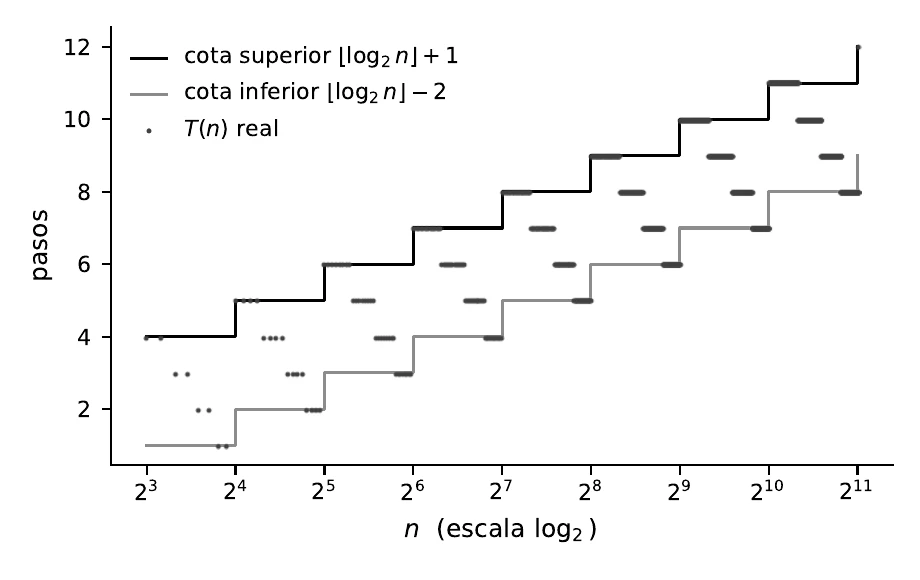 Figure 2. Upper and lower bounds of the band (3.2) (step lines) and actual value of T(n) for 8 ≤ n ≤ 2^11 (dots): the time always stays within the band, of constant width.
Proposition 3.6 (Extremal values).
- Powers of two (worst case): for k ≥ 3, T(2^k) = k+1 = ⌊log₂ 2^k⌋ + 1, which saturate the upper bound of (3.2).
- Mersenne numbers (fast convergence): for j ≥ 4, T(2^j − 1) = j−3, which attain the lower bound of (3.2) with equality, since L(2^j − 1) = j−1.
- One-step convergence: T(n) = 1 if and only if n ∈ {6, 14, 15}.
- Maximum in initial ranges: for N ≥ 8, max{T(n) : 8 ≤ n ≤ N} = ⌊log₂ N⌋ + 1, attained in particular at n = 2^⌊log₂ N⌋.
Proof. (a) For n = 2^k: L = k and ⌊2^k / 2^(k−2)⌋ = 4, so (3.1) gives T = k+5−4 = k+1.
(b) For n = 2^j − 1: L = j−1 and ⌊(2^j − 1) / 2^(j−3)⌋ = ⌊8 − 2^−(j−3)⌋ = 7, so T = (j−1)+5−7 = j−3. The lower bound of (3.2) is L−2 = j−3: equality.
(c) T(n) = 1 is equivalent to F₇(n) = 7 with n ≠ 7. If n < 7: n+1 = 7 gives n = 6. If n > 7 even: ⌊n/2⌋ = 7 gives n ∈ {14, 15}, and parity leaves n = 14. If n > 7 odd: ⌊(n−1)/2⌋ = 7 gives n ∈ {15, 16}, and parity leaves n = 15.
(d) By Corollary 3.5(b), every n in [2^L, 5·2^(L−2)) with L = L(N) satisfies T(n) = L+1; that interval contains 2^L ≤ N, and no larger value is possible by (3.2). □
Remark 3.7. Item (b) deserves emphasis: the Mersenne numbers 2^j − 1, far from being the «slowest» (as a superficial inspection of their binary expansion might suggest), attain the lower bound with equality. The closed form (3.1) immediately settles any conjecture of this kind: in this system there are no open questions left to solve, which is precisely the philosophical point of the article.
Figure 3 depicts both extremal families.
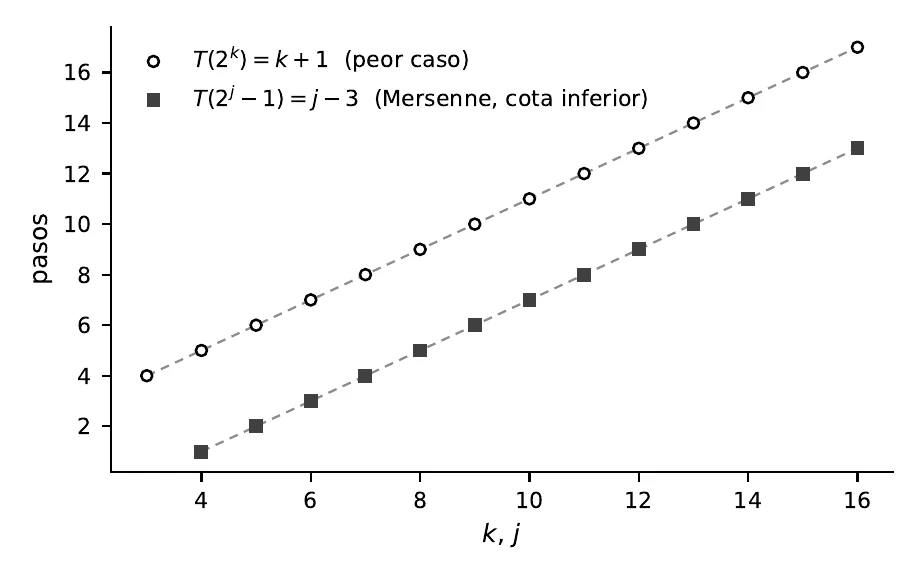 Figure 3. The two extremal families of Proposition 3.6: powers of two saturate the upper bound, T(2^k) = k+1 (circles), and Mersenne numbers attain the lower bound with equality, T(2^j − 1) = j−3 (squares).
3.4 Distribution of the convergence time
Theorem 3.8 (Uniform distribution over octaves). Let L ≥ 3 and let n be uniform over the dyadic octave Ω_L ≔ {2^L, 2^L + 1, …, 2^(L+1) − 1}. Then T(n) takes each of the values {L−2, L−1, L, L+1} with exact probability 1/4 (that is, for exactly 2^(L−2) values of n each). Consequently,
E[T | Ω_L] = L − 1/2, Var[T | Ω_L] = 5/4. (3.3)Proof. By Theorem 3.4, T(n) = L+5−m with m = ⌊n / 2^(L−2)⌋, and the value of T is determined by m ∈ {4, 5, 6, 7}. The four subintervals [m·2^(L−2), (m+1)·2^(L−2)), m = 4, 5, 6, 7, partition Ω_L and all have length 2^(L−2). The mean is ¼((L−2)+(L−1)+L+(L+1)) = L − ½, and the variance, ¼(9/4 + 1/4 + 1/4 + 9/4) = 5/4. □
Figure 4 shows this structure in the octave Ω₁₀.
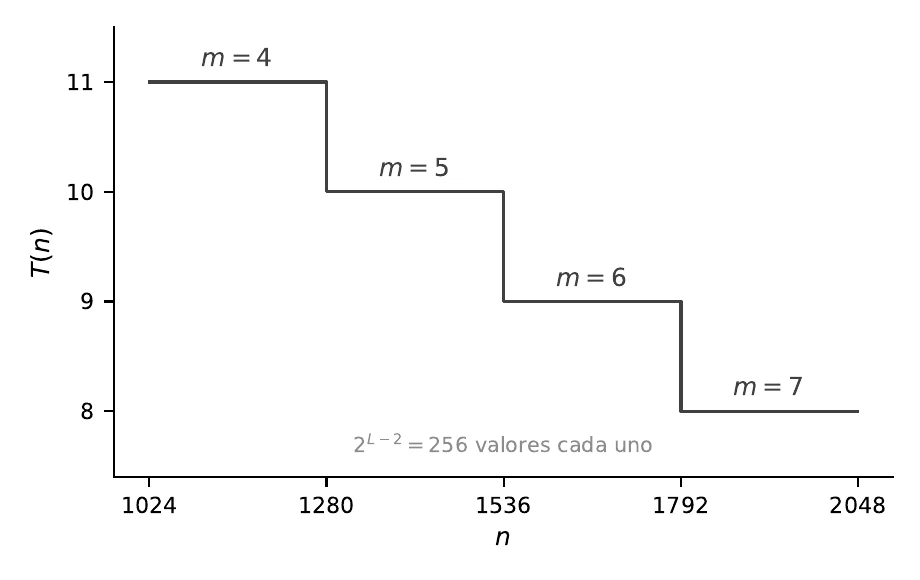 Figure 4. The time T in the octave Ω₁₀: four consecutive blocks of 2^(L−2) = 256 values with times 11, 10, 9, 8, determined by m = ⌊n / 2^(L−2)⌋ ∈ {4, 5, 6, 7} (Theorem 3.8).
Corollary 3.9 (Asymptotic mean). For n₀ uniform over {8, 9, …, 2^M − 1},
E[T(n₀)] = M − 5/2 + O(M·2^−M) = log₂ N − 5/2 + o(1), (N = 2^M − 1 → ∞).Proof. Conditioning by octaves and using E[T | Ω_L] = L − ½, it suffices to compute E[L] = (∑ L·2^L) / (∑ 2^L) = ((M−2)·2^M − 8) / (2^M − 8) = M − 2 + O(M·2^−M), where we used ∑_{L=0}^{M−1} L·2^L = (M−2)·2^M + 2. □
| n₀ | L = ⌊log₂ n₀⌋ | lower bound | T(n₀) | upper bound | regime |
|---|---|---|---|---|---|
| 6 | 1 | pure ascent | |||
| 14 | 3 | 1 | 1 | 4 | one step (direct image) |
| 15 | 3 | 1 | 1 | 4 | one step (direct image) |
| 63 | 5 | 3 | 3 | 6 | Mersenne 2⁶−1: lower bound |
| 64 | 6 | 4 | 7 | 7 | power of 2: upper bound |
| 100 | 6 | 4 | 5 | 7 | typical |
| 127 | 6 | 4 | 4 | 7 | Mersenne 2⁷−1: lower bound |
| 128 | 7 | 5 | 8 | 8 | power of 2: upper bound |
| 1000 | 9 | 7 | 7 | 10 | typical |
| 1024 | 10 | 8 | 11 | 11 | power of 2: upper bound |
Table 1. Representative cases: theoretical band versus actual value of T. For n₀ = 6 no bounds are shown because the band only applies to n > 7.
4. Computational verification
4.1 Methodology
All the preceding statements are proved theorems; the computational verification does not aim to replace the proofs but to test them against extensive domains and to produce reproducible evidence. The reference implementation, written in Python 3 with no external dependencies, computes orbits by direct iteration of the definition and times T(n) by dynamic programming (T(n) = 1 + T(F₇(n)) with memoization; cf. Cormen et al., 2009), which allows exhaustive sweeps in linear time. The source code, the generated data, and the execution instructions are public (see the availability statement at the end).
4.2 Scope of the verification
The following points were checked:
- Convergence and band: for every 1 ≤ n ≤ 10⁷, the orbit reaches 7 and, for n > 7, the band (3.2) holds. Without a single exception.
- Closed form: the identity (3.1) was verified for every 8 ≤ n ≤ 10⁷.
- Distribution by octaves: for each 3 ≤ L ≤ 23, the time T splits the octave Ω_L into four blocks of exactly 2^(L−2) values, with the times {L−2, L−1, L, L+1}, in accordance with Theorem 3.8.
- Global mean: over {8, …, 2²⁴ − 1} the empirical mean is 21.5, in exact agreement with Corollary 3.9 (M − 5/2 with M = 24).
- Large cases: trajectories and bounds for values of up to 11 digits (Table 2).
- Maxima: the maximum of T over {8, …, N} is attained at the largest power of 2 not exceeding N (Proposition 3.6(d)); for example, max{T(n) : n ≤ 10⁷} = 24, attained at n = 2²³.
| n₀ | T(n₀) | lower bound | upper bound | L = ⌊log₂ n₀⌋ |
|---|---|---|---|---|
| 1 000 000 | 17 | 17 | 20 | 19 |
| 10 000 000 | 24 | 21 | 24 | 23 |
| 2 147 483 647 | 28 | 28 | 31 | 30 |
| 98 364 526 374 | 36 | 34 | 37 | 36 |
Table 2. Large numbers: actual time versus theoretical band.
Note that 1 000 000 and 2 147 483 647 attain the lower bound with equality: they belong to the m = 7 regime of Theorem 3.4. Figure 5 contrasts the empirical mean per octave with the exact prediction of Theorem 3.8.
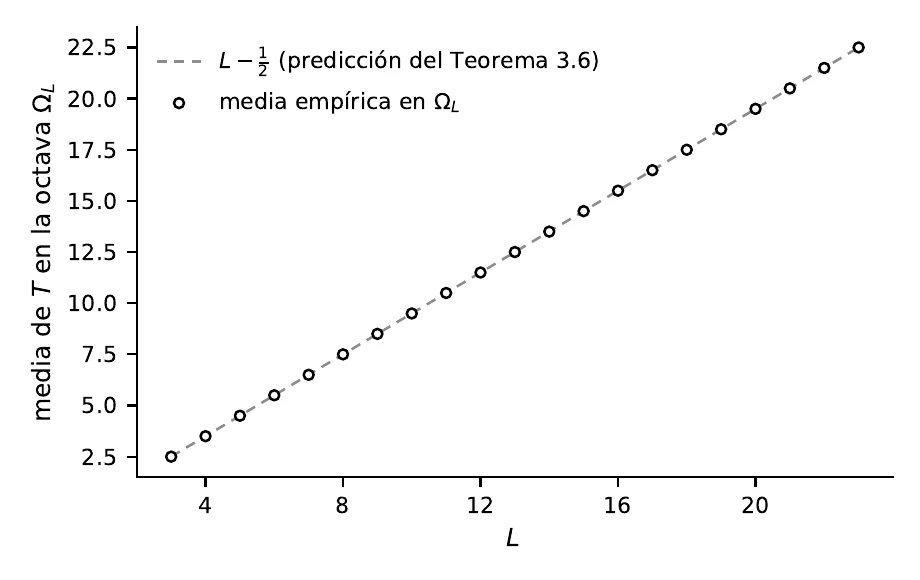 Figure 5. Empirical mean of T in each octave Ω_L, 3 ≤ L ≤ 23 (dots), versus the exact prediction L − ½ of Theorem 3.8 (dashed line): perfect agreement.
4.3 A critical reading of the evidence
Table 2 and the ten million verified cases constitute abundant, consistent, and exportable evidence. It is important to state clearly what that evidence is not: it is not cumulative indications about an open conjecture, because the result was proved beforehand and, above all, was guaranteed by construction. This is exactly the kind of evidence that numerology exhibits when it generates thousands of «confirmations» of its patterns: correct, massive data, empty of epistemic content. The volume of verification does not by itself distinguish a discovery from a manufacture; for that distinction the criteria of Section 7 are needed.
5. Comparison with genuine dynamical systems
The pedagogical value of the F₇ system is best appreciated by contrast with two classical, superficially similar iterative processes: the Collatz function and the Kaprekar process.
5.1 The Collatz conjecture
The Collatz function C(n) = n/2 if n is even and C(n) = 3n+1 if n is odd shares with F₇ the parity syntax and the study of iterated orbits. The resemblance ends there. In Collatz the odd rule produces transient growth not evidently bounded, trajectories are irregular (for example, 27 reaches 9232 before descending) and, after decades of study, no proof of general convergence is available (Lagarias, 2010). The generalized variants confirm the contrast from the other side: of the qx+r family only results where the problem is hard or divergent are published (Crandall, 1978; Franco and Pomerance, 1995), while the trivially convergent case does not even generate a question. In F₇ convergence is built into the very definition: each branch is oriented toward the fixed point and the complete quantitative theory fits in formula (3.1). The comparison delimits two notions that numerological rhetoric systematically confuses: mathematical difficulty (the absence of a theory explaining the behavior) and facade complexity (case notation around an elementary mechanism). Figure 6 illustrates the contrast for n₀ = 27.
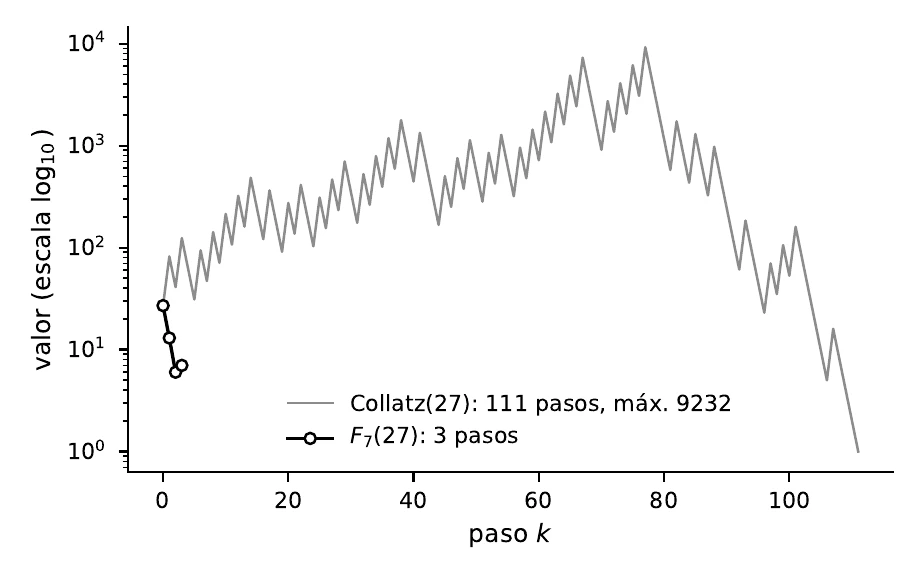 Figure 6. Contrast for n₀ = 27: the Collatz orbit (gray) needs 111 steps and reaches 9 232 before descending, while that of F₇ (black) reaches 7 in 3 steps. Genuine complexity versus facade complexity.
5.2 The Kaprekar process
The Kaprekar routine —sorting the digits of a four-digit number in ascending and descending order, subtracting, and iterating— converges to the constant 6174 for every non-repdigit number (Kaprekar, 1955). It is the closest antecedent to our system: a universal fixed point within its domain. There are, however, two structural differences. First, Kaprekar’s domain is finite (9 000 states), so convergence is verifiable by exhaustive inspection and the «depth» of the phenomenon is bounded by the very construction of the process; in F₇ the domain is infinite and convergence requires (and admits) proof. Second, and more relevant, 6174 was discovered as a fixed point of a dynamics given beforehand, whereas in F₇ the fixed point was chosen before defining the dynamics. The direction of causality —emergent property versus imposed property— is what separates a genuine mathematical curiosity from an artifact, and not even Kaprekar’s genuine curiosity implies that 6174 possesses mystical properties.
| Collatz | Kaprekar | F₇ (this work) | |
|---|---|---|---|
| Origin of the fixed point | unknown | discovered | imposed by design |
| Domain | ℕ (infinite) | finite (9 000 states) | ℕ (infinite) |
| Status of convergence | open conjecture | verifiable by exhaustion | theorem (proved here) |
| Transient growth | yes, irregular | bounded | no |
| Formula for the time | not known | tabulable | closed form (3.1) |
| Open questions it generates | yes | few | none (by design) |
Table 3. Structural comparison of the three iterative systems.
6. Generalizations and variants
6.1 The F_k family: the arbitrariness of the target
Definition 6.1. For fixed k ∈ ℕ, we define F_k: ℕ → ℕ by replacing the value 7 in the definition with k: fixed point at k, integer division above k, and unit increment below.
Theorem 6.2 (Arbitrariness of the convergence point). For every k ∈ ℕ and every n₀ ∈ ℕ, the orbit of n₀ under F_k reaches k in a finite number of steps. Moreover, for n₀ > k, the convergence time admits the same band ⌊log₂ n₀⌋ − C_k ≤ T_k(n₀) ≤ ⌊log₂ n₀⌋ + C_k with a constant C_k that depends only on k.
Proof (sketch). The proof of Theorem 3.1 carries over literally: above k there is strict decrease bounded below, and below k there is linear ascent to k. The band is obtained by replicating Lemma 3.3 with r = ⌊log₂ n₀⌋ − ⌊log₂ k⌋, which leaves the orbit in a neighborhood of fixed size around k. □
This is the conceptual blow of the article: F₁, F₁₃, F₄₂, or F₆₆₆ work with identical mechanics and identical rigor. If any number can become the «special point of universal convergence» of a formally impeccable system built in minutes, the specialness resides not in the number but in the constructor’s decision. The numerology of 7 is thus refuted not by rhetorical argumentation but by exhibition of the complete class of equivalent constructions. Figure 7 shows the orbits of n₀ = 1000 under three members of the family.
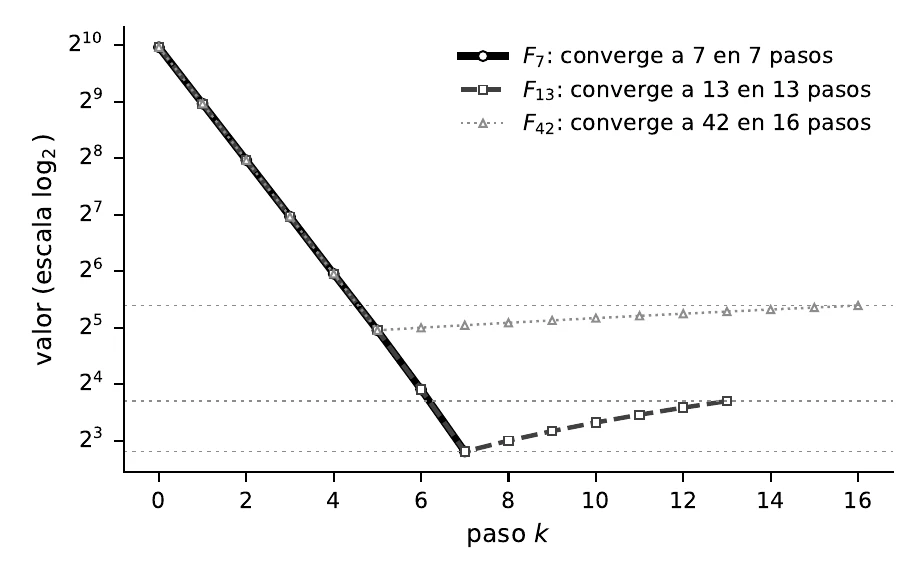 Figure 7. Orbits of n₀ = 1000 under F₇, F₁₃ and F₄₂ (Theorem 6.2). The three trajectories coincide in the descent while n > 42 and each stops upon reaching its own target k: the arbitrariness of the convergence point made visible.
6.2 Random variant
Consider the perturbation F₇’(n) that, for n > 7, chooses with probability 1/2 between ⌊n/2⌋ and ⌊(n−1)/2⌋ (both options coincide for odd n, so chance acts only on the even ones).
Proposition 6.3. Every realization of F₇’ converges to 7: convergence is deterministic in destination, and randomness affects only the length of the trajectory. Moreover, the expected convergence time is Θ(log n).
Proof (sketch). For n > 7, both options satisfy F₇’(n) ≤ n/2 < n and F₇’(n) ≥ 3; the decrease argument of Theorem 3.1 applies to each realization with no need for probability. Each step reduces the value at least to the factor (n−1)/2, which gives the Θ(log n) bound in expectation. □
Stochastic models of 3x+1 type, with random per-step multipliers (Lagarias and Weiss, 1992), offer the exact contrast: there chance decides the qualitative behavior of the orbit. The lesson is that adding noise to a manufacture does not turn it into a natural phenomenon: a «stochastic» system can still have its conclusion written into the rules. Figure 8 illustrates both claims for n₀ = 1000.
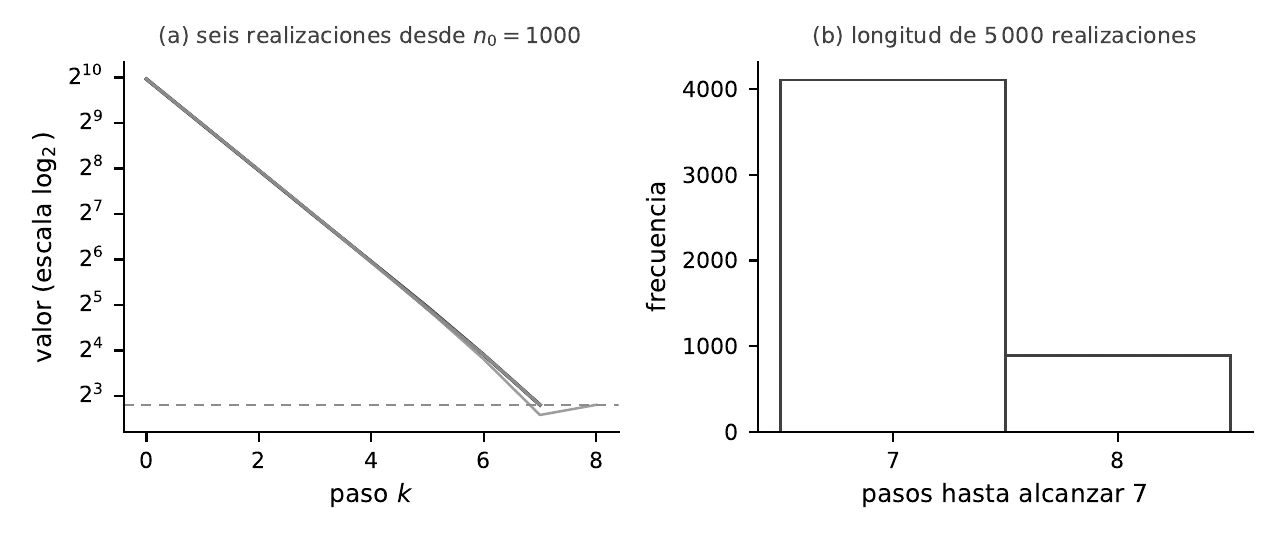 Figure 8. Random variant F₇’ (Proposition 6.3). (a) Six realizations from n₀ = 1000: the destination is always 7 and the trajectories barely differ. (b) Distribution of trajectory length over 5 000 realizations: randomness only slightly disperses the convergence time.
6.3 Extension to the reals: a correct analysis
It is natural to ask what happens when the system is extended to ℝ⁺ via
G(x) = x      if x = 7
       x/2    if x > 7
       x + 1  if x < 7
A naive analysis would claim that every x converges to 7. The true result is finer and more instructive, and it is worth stating precisely, because the honesty of the example depends on it. Continuous extensions of the 3x+1 problem demand considerable real-dynamics tools (Chamberland, 1996); the extension above, once again by construction, is solved with elementary arithmetic.
Proposition 6.4 (Dynamics of G). Let B ⊂ ℝ⁺ be the backward orbit of 7 under G (the smallest set containing 7 and closed under x ↦ 2x and x ↦ x−1 restricted to the appropriate domain). Then:
- B is countable, and G^j(x) = 7 for some j if and only if x ∈ B.
- If x ∉ B, the orbit never reaches 7 and its ω-limit set is {4, 5, 6, 7}: the distance of the orbit to that set decays geometrically with ratio 1/2 per excursion cycle.
Proof (sketch). (a) The preimages of 7 are generated by x ↦ 2x (valid for x > 7) and x ↦ x−1 (valid for x < 7); a countable union of finite sets is countable.
(b) If x > 7, successive halvings deposit the orbit in (3.5, 7]; the value 7 corresponds to case (a). If the orbit lies in (3.5, 7) without falling into B, unit increments take it to a value in (7, 8), whose half falls in (3.5, 4). From z ∈ (3.5, 4), the orbit describes z ↦ z+1 ↦ z+2 ↦ z+3 ↦ z+4 ↦ (z+4)/2, that is, the minimum of each excursion evolves by g(z) = (z+4)/2, a contraction of ratio 1/2 with fixed point 4. The successive minima z_j → 4⁻, and the corresponding points of the excursion tend to 5, 6, and 7 respectively. □
Example 6.5. For x = φ = (1+√5)/2 the orbit is 2.618…, 3.618…, …, 6.618…, 7.618…, 3.809…, …, and it never reaches 7: φ is not a dyadic rational, hence φ ∉ B. By contrast, x = 7/2 produces excursion minima 15/4, 31/8, 63/16, … = 4 − 2^−j, which confirm the geometric contraction toward the limit cycle. Claiming that «every real converges to 7» would be false: it is true only on the countable set B and as an asymptotic limit on the rest. Figure 9 illustrates both facts.
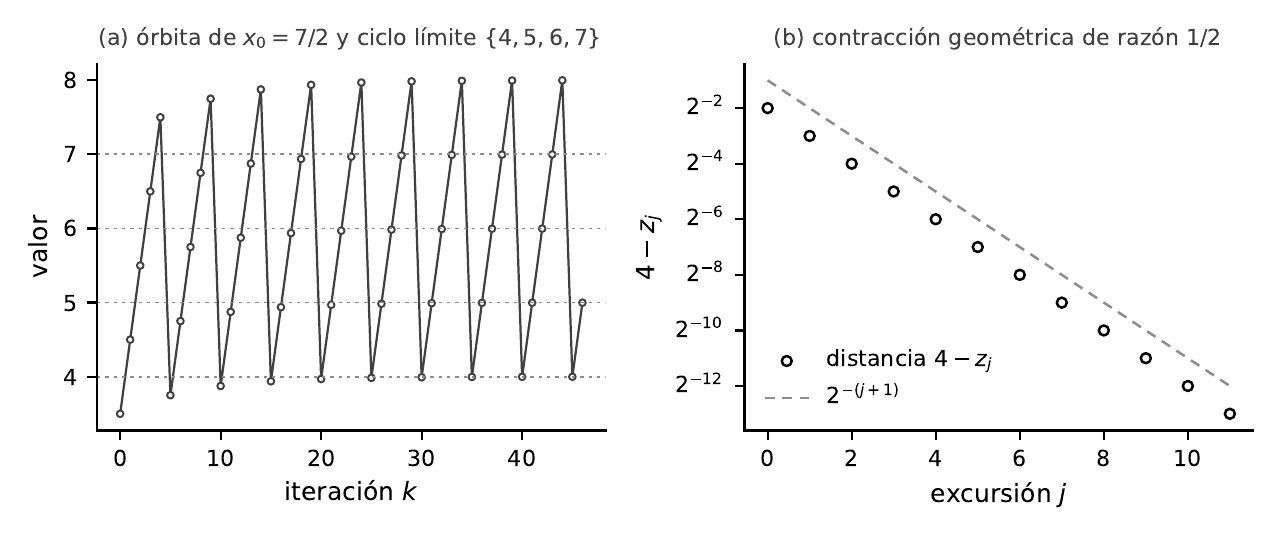 Figure 9. Extension to ℝ⁺ (Proposition 6.4). (a) Orbit of x₀ = 7/2: it never reaches 7 and approaches the limit cycle {4, 5, 6, 7}. (b) The distance of the excursion minima z_j to 4 decays like 2^−(j+1), a geometric contraction of ratio 1/2.
Even when changing domains, the system reveals its nature: the exact fixed point remains reserved for a measure-zero set designed upstream from the target, and the generic behavior is a limit cycle, not a «mystical attractor».
7. Discussion: rigor, meaning, and demarcation
7.1 What this experiment proves and what it does not
The F₇ system satisfies all the external marks of a serious mathematical result: precise definitions, theorems with complete proofs, optimal bounds, exact distribution, and exhaustive computational verification. And yet it was built with the conclusion built in. The experiment thus separates three levels that numerological discourse deliberately mixes:
- Internal validity: the logical correctness of the statements within their formal framework. F₇ possesses it completely.
- Volume of evidence: the amount of accumulated verification. F₇ possesses it to an extreme degree (10⁷ exhaustive cases, plus the theorems).
- Knowledge value: the capacity of the result to connect with other theories, to open non-trivial questions, to be falsified, or to explain something beyond its own framework. F₇ lacks it by design.
The central thesis is that formal correctness is a necessary but not sufficient condition for mathematical meaning. This does not devalue rigor (without it there is no mathematics), but situates it: rigor is a neutral tool, capable both of articulating fruitful theories and of encapsulating empty artifacts with an appearance of depth. Recognizing this is not relativism: it is what allows defending the integrity of mathematics against its imitations, in the line of the classic criticisms of Gardner (1957, 1985).
7.2 Heuristic criteria of significance
How, then, to distinguish a genuine result from a rigorous manufacture? We propose, as a heuristic framework and not as a formalism (for formalizing it would fall into the same pseudoformal inflation criticized here), five criteria that emerge directly from the contrast between F₇ and recognizably valuable mathematics:
- Connectivity: the result relates to theoretical bodies independent of it. Fermat’s Last Theorem connected number theory and algebraic geometry; F₇ connects with nothing but itself.
- Generativity: the result opens new, non-trivial questions. Collatz has resisted eighty years of attacks and has generated mathematics by resisting (Lagarias, 2010); about F₇ no open question remains after formula (3.1).
- Unforced emergence: the property was not written into the rules. Kaprekar’s constant 6174 emerged from a given dynamics; the 7 of F₇ was chosen before the dynamics.
- Effective falsifiability: there is a conceivable observation that would refute the central claim (Popper, 1959). «Everything converges to 7 under F₇» is not falsifiable in practice because the definition guarantees it; numerological predictions are analogously immunized through ad hoc reinterpretations.
- Explanatory parsimony: the machinery employed is minimal relative to what is explained. F₇ exhibits the inverse relation: a parity partition (Remark 2.2) that explains nothing the simple version does not explain.
Under these criteria, genuine mathematical beauty —the kind Hardy associated with seriousness and economy of ideas (Hardy, 1940)— is distinguished from ornamentation: the former emerges from unsought connections, as in the identity e^(iπ) + 1 = 0; the latter is manufactured by adding cases, notation, and noise. The well-known «unreasonable effectiveness» of mathematics in science (Wigner, 1960) points to the same contrast from the applied side: genuine structures reappear in unforeseen contexts; manufactured ones only «work» within the narrow scenario for which they were written.
7.3 The general mechanism of pseudomathematics
The F₇ case is a controlled instance of a general mechanism. A numerological system can be described informally as a triple (A, f, I): an alphabet or domain A, a coding rule f chosen without structural restriction, and an interpretive layer I that assigns non-falsifiable meanings to the numerical outputs. The typical architecture combines arbitrariness in f, immunity to refutation in I, narrative circularity, and biased selection of favorable cases (McKay et al., 1999; Simmons et al., 2011). Given any finite set of «predictions», there always exists a pair (f, I) that «confirms» them: it suffices to fix f so that the observed cases fall into prefixed classes and to adjust I to the desired reading.
A second artifact illustrates the generality of the procedure. Define over proper names the alphabetic sum followed by digital reduction R(n) into the range {1, …, 9}. The «theorem» value(s) ∈ {1, …, 9} for every name s is correct, computable, and tautological: the conclusion is encoded in the definition of R. From there, «correlations» can be manufactured (class 7 with leadership, compatibilities by modular distance, etc.) with full «computational reproducibility» and zero causal mechanism. The structure of the deception is identical to that of F₇; only the wrapping changes.
This reading dialogues with the philosophical tradition: with constructivism, which already warned that mathematical objects are human constructions (Brouwer, 1907; Bishop, 1967); with Lakatos, for whom genuine mathematics evolves by criticism and refutation while pseudomathematics only accumulates layers (Lakatos, 1976); with Wittgenstein, before whom the «necessity» exhibited by a rule game may be mere convention (Wittgenstein, 1956); and with the view of mathematics as fallible human activity of Davis and Hersh (1981), which explains why empty mathematics can be built as easily as deep mathematics.
7.4 Implications for education and outreach
The construction has direct teaching value. First, as contrast material in courses on dynamical systems or elementary number theory: it allows teaching fixed points, orbits, bounds, and time distribution with a completely solvable system, before confronting students with genuinely open problems (the comparison in Table 3 is itself a lesson). Second, as a tool for critical literacy: showing the system with its confession of manufacture included teaches how to detect the signals of pseudomathematics (cosmetic complexity, massive evidence without falsifiability, theoretical isolation) better than any abstract warning. It is the strategy running through the work of Dudley (1992, 1997): confronting pseudomathematics with concrete cases rather than general principles. Usual mathematics education teaches how to produce mathematics; it rarely teaches how to detect manufactured mathematics, and that asymmetry leaves the public defenseless before numerology with technical syntax.
8. Limitations
Three limitations delimit the scope of the work. (i) The results on F₇ are elementary by necessity of the argument: their very easiness is the thesis, so the article contributes no new mathematical technique to the study of dynamical systems. (ii) The demarcation criteria of Section 7 are heuristic and do not claim to constitute a formal theory of significance; formalizing them would fall into the same excess being criticized. (iii) The work shows that manufacture is possible and easy, but does not study empirically why such manufactures persuade: that question belongs to cognitive psychology and the sociology of knowledge, and constitutes a line of future work (for example, assessing in the classroom whether the F₇/Collatz contrast improves students’ detection of pseudomathematics).
9. Conclusions
We have built a discrete dynamical system in which every natural number converges to 7, we have developed its complete quantitative theory (universal convergence, closed form for the convergence time, optimal band, extrema, and uniform distribution over octaves), and we have verified it exhaustively up to 10⁷. The same construction works for any target k, which shows that the «specialness» of a number can be manufactured at will with complete formal rigor. The epistemological conclusion stands without rhetoric: internal validity, volume of evidence, and knowledge value are independent properties, and only the third distinguishes genuine mathematics from its imitations. The fantasy of 7, presented with its manufacture in plain sight, is thus placed at the service of mathematics education and the criticism of pseudoscience.
Code and data availability
All source code (reference implementation, interactive verifier, CSV export, and trajectory graphs), the verification data, and the reproduction instructions are public in the repository: github.com/686f6c61/conjetura-falso-7. The PDF manuscript and its LaTeX source are also there. The exhaustive verification of Section 4 was carried out with a program independent of the repository’s interactive code.
Reproducibility
The individual verification of any n reduces to a few lines; the repository also includes an interactive verifier, CSV export of results, trajectory-graph generation, and the script used to produce the figures in this article.
def F7(n):
    if n == 7: return 7
    if n > 7:  return n // 2 if n % 2 == 0 else (n - 1) // 2
    return n + 1

def orbita(n0):
    o = [n0]
    while o[-1] != 7: o.append(F7(o[-1]))
    return o
Listing 1. Complete implementation of F₇ and of orbit computation (6 effective lines).
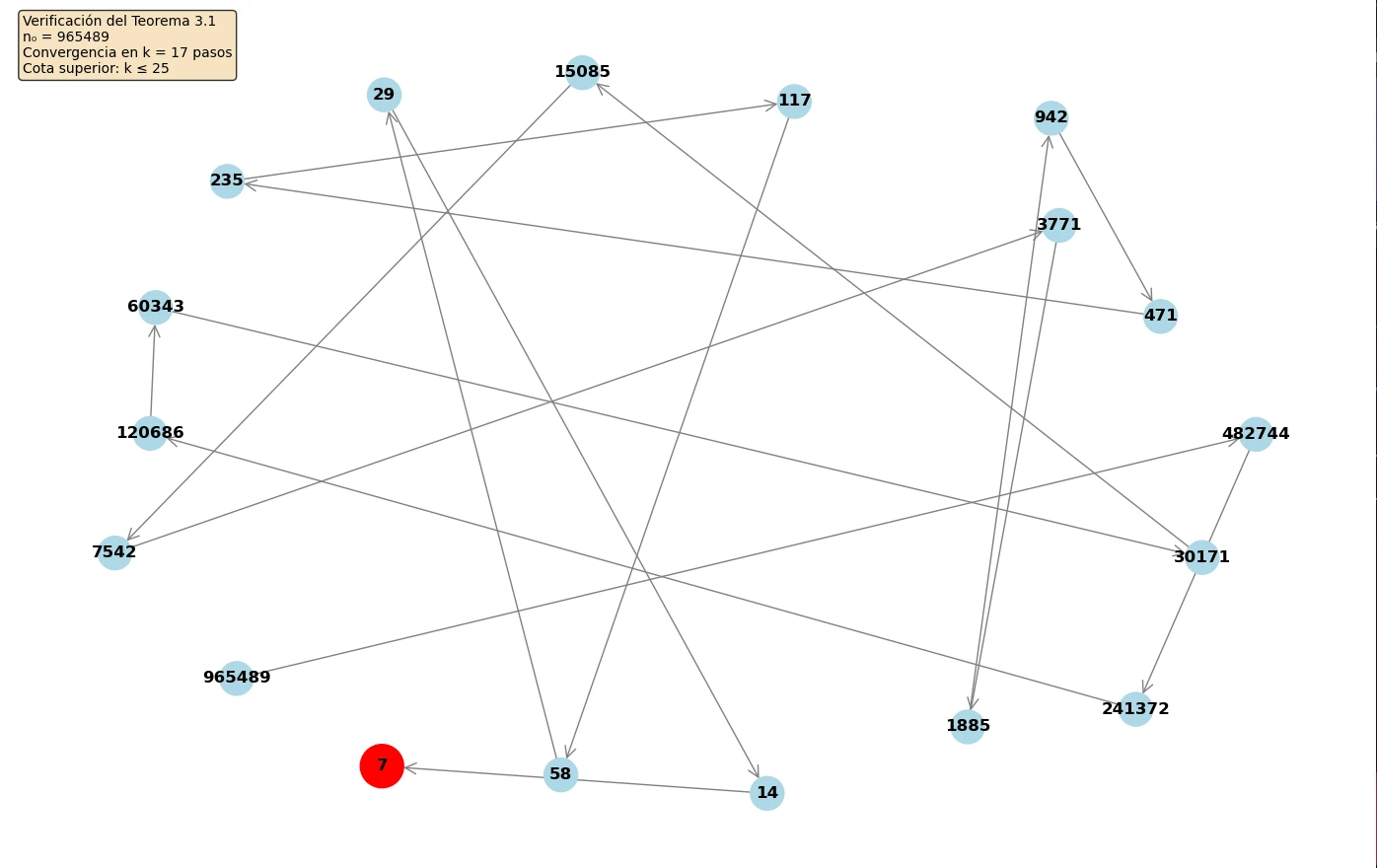 Figure 10. Example of a trajectory graph for n₀ = 965 489, generated by the repository’s interactive tool (
scripts/demostraciones.py).
References
- 686f6c61. (2025). conjetura-falso-7: la fantasía del 7 [Software]. GitHub.
- Bishop, E. (1967). Foundations of Constructive Analysis. McGraw-Hill, New York.
- Blancke, S., Boudry, M. and Pigliucci, M. (2017). Why do irrational beliefs mimic science? The cultural evolution of pseudoscience. Theoria, 83(1), 78-97.
- Brouwer, L. E. J. (1907). Over de grondslagen der wiskunde [On the foundations of mathematics]. Doctoral dissertation, University of Amsterdam.
- Chamberland, M. (1996). A continuous extension of the 3x+1 problem to the real line. Dynamics of Continuous, Discrete and Impulsive Systems, 2(4), 495-509.
- Conway, J. H. (1987). FRACTRAN: A simple universal programming language for arithmetic. In T. M. Cover and B. Gopinath (Eds.), Open Problems in Communication and Computation (pp. 4-26). Springer, New York.
- Cormen, T. H., Leiserson, C. E., Rivest, R. L. and Stein, C. (2009). Introduction to Algorithms (3rd ed.). MIT Press, Cambridge, MA.
- Crandall, R. E. (1978). On the «3x+1» problem. Mathematics of Computation, 32(144), 1281-1292.
- Davis, P. J. and Hersh, R. (1981). The Mathematical Experience. Birkhäuser, Boston.
- Devaney, R. L. (2003). An Introduction to Chaotic Dynamical Systems (2nd ed.). Westview Press, Boulder.
- Diaconis, P. and Mosteller, F. (1989). Methods for studying coincidences. Journal of the American Statistical Association, 84(408), 853-861.
- Dudley, U. (1992). Mathematical Cranks. Mathematical Association of America, Washington, DC.
- Dudley, U. (1997). Numerology: Or, What Pythagoras Wrought. Mathematical Association of America, Washington, DC.
- Franco, Z. and Pomerance, C. (1995). On a conjecture of Crandall concerning the qx+1 problem. Mathematics of Computation, 64(211), 1333-1336.
- Gardner, M. (1957). Fads and Fallacies in the Name of Science (2nd rev. ed.). Dover, New York.
- Gardner, M. (1985). The Magic Numbers of Dr. Matrix. Prometheus Books, Buffalo.
- Guy, R. K. (1983). Conway’s prime producing machine. Mathematics Magazine, 56(1), 26-33.
- Hardy, G. H. (1940). A Mathematician’s Apology. Cambridge University Press, Cambridge.
- Kaprekar, D. R. (1955). An interesting property of the number 6174. Scripta Mathematica, 21, 304.
- Lagarias, J. C. (Ed.) (2010). The Ultimate Challenge: The 3x+1 Problem. American Mathematical Society, Providence.
- Lagarias, J. C. and Weiss, A. (1992). The 3x+1 problem: Two stochastic models. Annals of Applied Probability, 2(1), 229-261.
- Lakatos, I. (1976). Proofs and Refutations: The Logic of Mathematical Discovery (J. Worrall and E. Zahar, Eds.). Cambridge University Press, Cambridge.
- Lange, M. (2010). What are mathematical coincidences (and why does it matter)? Mind, 119(474), 307-340.
- McKay, B., Bar-Natan, D., Bar-Hillel, M. and Kalai, G. (1999). Solving the Bible code puzzle. Statistical Science, 14(2), 150-173.
- Pétard, H. (1938). A contribution to the mathematical theory of big game hunting. American Mathematical Monthly, 45(7), 446-447.
- Pigliucci, M. and Boudry, M. (Eds.) (2013). Philosophy of Pseudoscience: Reconsidering the Demarcation Problem. University of Chicago Press, Chicago.
- Popper, K. R. (1959). The Logic of Scientific Discovery. Hutchinson, London.
- Simmons, J. P., Nelson, L. D. and Simonsohn, U. (2011). False-positive psychology: Undisclosed flexibility in data collection and analysis allows presenting anything as significant. Psychological Science, 22(11), 1359-1366.
- Sokal, A. D. (1996). Transgressing the boundaries: Towards a transformative hermeneutics of quantum gravity. Social Text, 46/47, 217-252.
- Tupper, J. (2001). Reliable two-dimensional graphing methods for mathematical formulae with two free variables. In Proceedings of SIGGRAPH 2001 (pp. 77-86). ACM Press, New York.
- Wigner, E. P. (1960). The unreasonable effectiveness of mathematics in the natural sciences. Communications on Pure and Applied Mathematics, 13(1), 1-14.
- Wittgenstein, L. (1956). Remarks on the Foundations of Mathematics (G. H. von Wright, R. Rhees and G. E. M. Anscombe, Eds.; G. E. M. Anscombe, Trans.). Basil Blackwell, Oxford.
- Witztum, D., Rips, E. and Rosenberg, Y. (1994). Equidistant letter sequences in the Book of Genesis. Statistical Science, 9(3), 429-438.
- Wonham, W. M. (1967). On pole assignment in multi-input controllable linear systems. IEEE Transactions on Automatic Control, 12(6), 660-665.